Part 2: 505(b)(2) NDA – The Importance Early-Stage Planning

The unique aspects of the 505(b)(2) submission structure and label claims are perhaps best illustrated at the pre-IND planning stage. Whereas for a new chemical entity, pre-IND discussion is generally focused on the determination of a safe starting dose in humans, the 505(b)(2) discussion will be focused around unsupported label claims and getting FDA agreement on the plan to address those claims in clinical development.
This dramatic difference in early objectives can feel vertiginous to teams unfamiliar with the process, and it is critical that team members understand the expectations and commitment required to successfully navigate the Pre IND discussion. For a 505(b)(2), a lack of clarity after pre-IND discussions can have the same effect as the lack of clarity following an end-of-phase 2 meeting for a 505(b)(1) product—they put the program at risk for serious delays.
There are a couple of tools that are useful in getting the most out of the Pre-IND planning process: the target product profile (TPP) and gap analysis.
TPP and gap analysis
The TPP is a format that systematically associates labeling concepts and supportive data. Sponsors should familiarize themselves with the FDA draft guidance, which details the concept and its uses.
The particular utility of the TPP in 505(b)(2) planning lies in identifying the existence of any gaps between the proposed study drug labeling, the labeling of the proposed RLD, and any additional sources of safety and efficacy data. Done correctly, TPP construction and gap analysis are essentially a single exercise—a completed TPP should reveal the gaps.
To make the TPP as complete as possible, sponsors should consider the following:
- What is known about the relative bioavailability of the study drug vs the reference drug?
- If there are differences in relative bioavailability, what is known about the effect of these differences on safety and efficacy?
- If the proposed indication for the study drug is different from the RLD, what is known about efficacy in the indication?
- What new information has become available since the RLD was approved?
These questions should be addressed in the context of a thorough literature search at the time of TPP preparation. In scope, the literature search should cover both clinical and nonclinical research. While reference to the RLD may eliminate the need to conduct non-clinical studies, this should not be taken for granted at the Pre-IND stage.
As the literature search is a significant undertaking, it is important to get the most out of it by consolidating efforts across multiple documents, including the TPP, Briefing Document, Investigators Brochure, and the IND non-clinical summaries. An IND that builds logically on a TPP leads naturally to an NDA that builds logically to an annotated label.
Understanding the FDA’s thinking on how relative bioavailability informs the need for additional safety and efficacy studies is also critical at this stage. Sponsors should keep an eye out for FDA publications, such as the recent guidance on Depot Buprenorphine Products, which detail specific PK parameters that may lead to the need for additional safety/efficacy studies. FDA summary review documents on related compounds can be another good source of information.
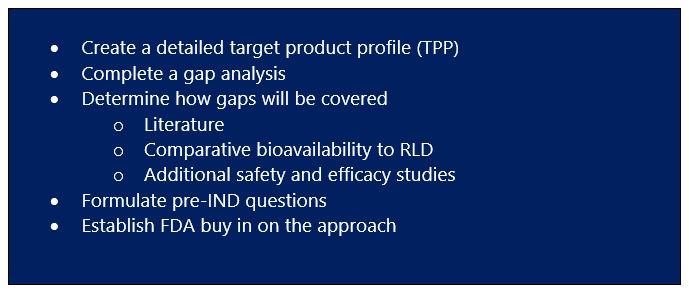
Once the literature search is complete, and the gaps are identified, any uncertainty around the proposed approach to addressing these gaps forms the basis of the Pre-IND questions to the FDA. Buy-in on this approach forms the basis of the clinical development plan and sets the sponsor up for long-term success, regardless of the complexity of the program.
Figure 1: Key 505(b)(2) Pre-IND goals
Keeping the Tools Sharp During Maintenance Phase
The tools developed during Pre-IND planning stage require continued sharpening during the IND maintenance phase. Ongoing evaluation of literature, RLD labeling, and safety databases are critical for keeping the TPP up-to-date.
Sponsors should also identify any literature considered essential to approval as early as possible. This may not be practical at the Pre-IND stage, but it must be done in advance of the Pre-NDA discussion.
The definition of “essential” relates back to the definition of the 505(b)(2): full reports of safety and effectiveness, where at least some of the information required for approval comes from studies not conducted by or for the applicant. Sponsors should consult the Clinical Evidence for Effectiveness guidance for more detail on the circumstances under which literature reports may be considered essential.
Because the bar is very high, attempts should be made to obtain source records and confirm that any candidate studies were conducted under good clinical practices. Where the FDA deems a published report insufficient to make a regulatory decision, data from that report will be considered supportive only. At the pre-NDA stage, data considered to be only supportive should not stand alone for any labeling language. The TPP is a good tool to ensure that this is the case.
Following the completion of relative bioavailability studies, safety/efficacy studies, and the identification of essential literature, additional gap analyses should be conducted to identify any remaining issues. These issues will form the basis of the Pre-NDA discussion.
Pre-NDA Planning
Pre-NDA planning and strategy should follow logically from the gap analysis described above. To get specific answers from the FDA, each labeling claim should reference source data within the submission structure with the greatest possible specificity.
All of the planning done to this point builds to that objective.
The Importance of Strategic Partnering
Because the stakes are so high early in development, strategic partnering can be critical to a successful 505(b)(2) project. The benefits of early success carry over throughout development, creating a high dividend for early involvement.
At MMS Holdings, we are a data-driven CRO and data drives our approach to 505(b)(2) planning. Like the 505(b)(2) application itself, our scenarios for partnering vary depending on the unique challenges of the application and always fixed on the same goal: a complete application where each label claim is supported by specific data.
by Ben Kaspar
About the author
Ben Kaspar is Global Submissions Manager at MMS, based in San Diego, California.
Suggested For You

perspectives
July 30th, 2024
The Critical Role of Quality Control (QC) – Medical Writing and Beyond
perspectives
July 23rd, 2024
PSI 2024 Ignited Conversations on External Data Sources, Requirements for Estimands, and Bayesian Methodology for Statisticians in Pharma

perspectives
July 16th, 2024
Key Steps to Successful CMC Authoring of IND and IMPD Submissions

perspectives
July 9th, 2024
Managing RTOR Submissions: How to Run a Successful Race from the Top Line Starting Line

perspectives
July 2nd, 2024
Part 1: RWD Noninterventional Study Design and FDA Engagement Opportunity for Early Stage Oncology

perspectives
June 21st, 2024
Peer-Reviewed Journal Articles: The Crucial Role of Publication in the Pharmaceutical Industry

perspectives
June 14th, 2024
A Structured Approach to Benefit-Risk Assessment Throughout Product Development in the Pharmaceutical Industry

perspectives
June 6th, 2024
Datacise and Diversity in Patient Enrollment: Combining Geospatial and Demographic Data to Aid Site Selection

perspectives
May 29th, 2024
Confined Deferrals in Clinical Trial Applications: Anticipating the Revised EU CTR Transparency Rules

perspectives
May 21st, 2024
Psychedelics and Regulatory Considerations Part II: A Shift in Lexicon and Implications of “Nonmedical Use” On Labelling

perspectives
May 10th, 2024
Psychedelics in Drug Development and Regulatory Considerations Part I: Benefit-Risk

perspectives
April 29th, 2024
Validation of Clinical Dashboards for Decision Making