Automatiqc®: Bridging the Gap Between AI Precision and Human Expertise in Medical Writing and Quality Control

In today’s fast-paced world, the blend of technology and human expertise is transforming various industries, including Clinical Research Organizations (CROs). At MMS, we lead this change, tapping into state-of-the-art technology while valuing the unmatched role of human intuition and judgment.
Our secret weapon? Automatiqc®. This one-of-a-kind proofreading tool combines AI’s precision with the insight of our skilled professionals, revolutionizing our approach to document formatting and style.
In this blog, we’ll explore how Automatiqc® is rewriting the rules, enhancing efficiency, and upholding the finest quality in medical writing (MW) and quality control (QC).
MMS brings a unique set of benefits to the table, distinguishing us from other CROs. But our most important asset is our people. By integrating established techniques with advanced technology, our team delivers exceptional results.
A prime example of this successful approach is Automatiqc®. Developed in-house at MMS, this custom proofreading tool leverages Robotic Process Automation (RPA)—a form of Artificial Intelligence (AI)—to streamline style and formatting updates for Microsoft® Word documents. This significantly reduces the need for manual adjustments.
Contrary to the generative AI tools that have been gaining attention recently, Automatiqc relies solely on human expertise to establish and modify its governing rules. Each item undergoes independent processing and review, based on these selected rules. Importantly, Automatiqc® ensures security; the application and all related information stay within the confined MMS system, thereby protecting our sponsors’ confidential and sensitive details.
Developed using Agile methodology, Automatiqc® has evolved to accommodate not only the MMS Style but also the style guides of numerous other sponsors. The Agile approach, with its step-by-step or ‘sprint’ process, gives MMS teams the adaptability to manage evolving tech requirements and promptly respond to inevitable changes. Compatible with most MMS and sponsor toolbars and templates, Automatiqc operates by spotting deviations from the defined rules, making necessary corrections, and logging each change. This allows the writer or reviewer to determine if the adjustment suits the context. Let’s delve into how it operates:
For example, here is the original text (note the margins):
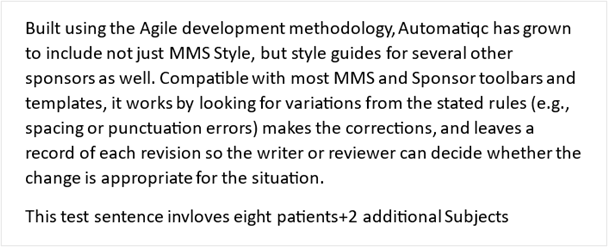
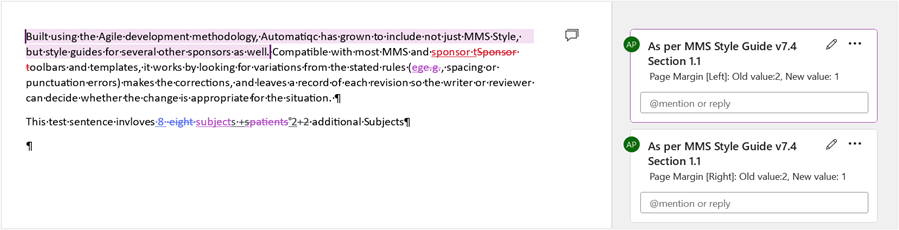
Once processed, we can observe the modifications made, evident from the tracked changes. Automatiqc® adjusted the margins to adhere to the standard 1” on all sides. It’s also noticeable where it applied rules for punctuation and usage:
Ultimately, once we’ve accepted or declined the changes as needed, we arrive at the final product:
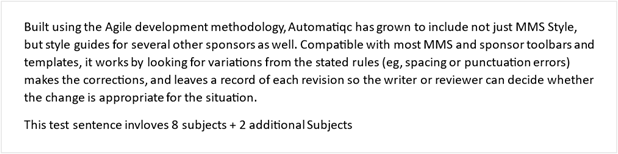
Automatiqc enhances efficiency for both medical writing (MW) and quality control (QC). Medical writers value Automatiqc® as it tackles minor formatting concerns, leaving them to concentrate on content clarity, completeness, accuracy, and other high-priority tasks.
During the QC process, Automatiqc® enables our QC team to review documents more swiftly, dedicating less time to checking fixed rules. Like MWs, once basic formatting is validated, the tool allows QC reviewers to invest more time in content analysis.
Overall, Automatiqc® is a beneficial tool that boosts efficiency and offers a wide range of expansion possibilities. Technology can be impressive in identifying potential errors, but it often overlooks the subtleties of language and context. By requiring human approval for its suggested changes, Automatiqc® ensures these nuances are maintained.
Authored by: Julie Aronson, Senior Scientific Document Reviewer
Suggested For You

perspectives
July 30th, 2024
The Critical Role of Quality Control (QC) – Medical Writing and Beyond

perspectives
July 23rd, 2024
PSI 2024 Ignited Conversations on External Data Sources, Requirements for Estimands, and Bayesian Methodology for Statisticians in Pharma

perspectives
July 16th, 2024
Key Steps to Successful CMC Authoring of IND and IMPD Submissions

perspectives
July 9th, 2024
Managing RTOR Submissions: How to Run a Successful Race from the Top Line Starting Line

perspectives
July 2nd, 2024
Part 1: RWD Noninterventional Study Design and FDA Engagement Opportunity for Early Stage Oncology

perspectives
June 21st, 2024
Peer-Reviewed Journal Articles: The Crucial Role of Publication in the Pharmaceutical Industry

perspectives
June 14th, 2024
A Structured Approach to Benefit-Risk Assessment Throughout Product Development in the Pharmaceutical Industry

perspectives
June 6th, 2024
Datacise and Diversity in Patient Enrollment: Combining Geospatial and Demographic Data to Aid Site Selection

perspectives
May 29th, 2024
Confined Deferrals in Clinical Trial Applications: Anticipating the Revised EU CTR Transparency Rules

perspectives
May 21st, 2024
Psychedelics and Regulatory Considerations Part II: A Shift in Lexicon and Implications of “Nonmedical Use” On Labelling

perspectives
May 10th, 2024
Psychedelics in Drug Development and Regulatory Considerations Part I: Benefit-Risk

perspectives
April 29th, 2024
Validation of Clinical Dashboards for Decision Making